
TESS-Net — trust-aware event-guided deblurring
Estimating where event-camera evidence is reliable, then using it only there, to restore a sharp image from a single motion-blurred frame.
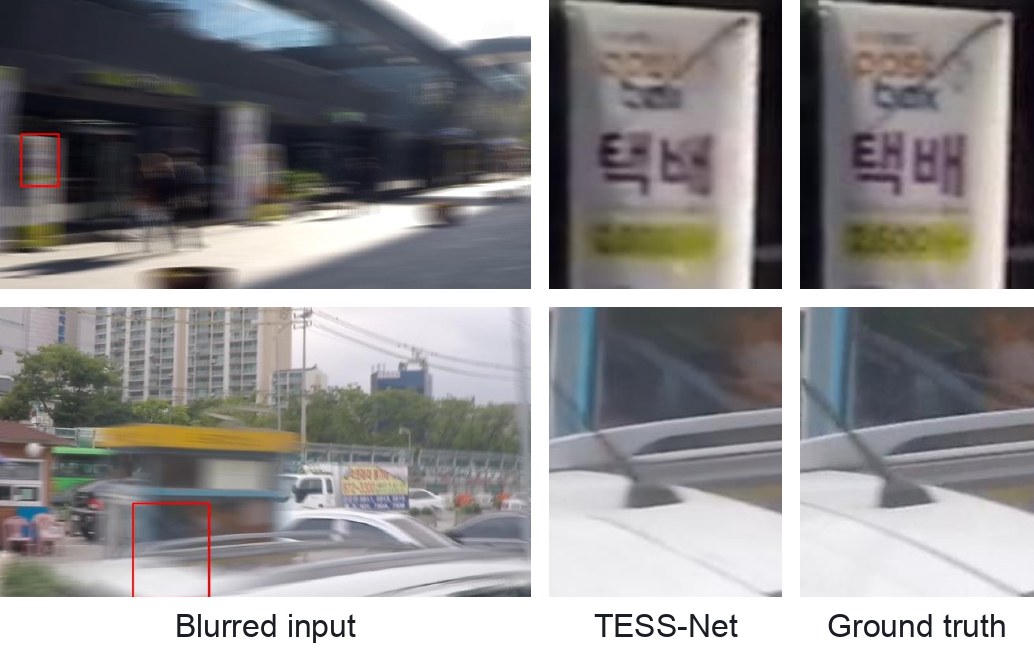
Under fast motion, a single RGB frame loses the fine structure and texture needed to undo its own blur, which makes image-only deblurring ill-posed. Event cameras record brightness changes asynchronously throughout the exposure, so they carry exactly the motion and edge evidence the blurred frame is missing. But that evidence is not uniformly trustworthy: events are sparse, noisy where contrast is weak, and can be structurally misaligned with the image. Methods that treat every event the same inject false structure wherever the two disagree.
TESS-Net makes reliability an explicit, spatial quantity. A Trust Map Estimation module predicts a dense, pixel-wise trust map from two complementary signals: a coarse structural consistency gate, measured as the disagreement between RGB and event features in a shared latent space, and a fine-grained event evidence map, obtained by selecting the temporal voxel bin holding the sharpest edges at each patch. Their fusion decides where event cues should be allowed to act.
That one signal then governs the rest of the network:
- Trust-Conditioned Fusion (TCF) gates event-to-RGB feature transfer, so fusion happens only where events are both structurally consistent with the image and locally strong enough to mean something.
- Trust-Conditioned Dual-Direction SSM (TD²-SSM) modulates the discretization step of a selective-scan state-space backbone with the trust map, so high-trust regions update state quickly from local event evidence while low-trust regions propagate cleaner historical context across long spatial ranges.
- Event-Edge Guided Router (EER) combines the horizontal and vertical scan candidates by how well each preserves the true edges in the event stream, and applies that preference only where events are actually present.
Results
From a single blurred frame, TESS-Net achieves the best restoration accuracy among single-image event-guided methods on the synthetic GoPro benchmark and on the real-world HighREV and REBlur recordings, and stays competitive with methods that have a whole video to work from.
Publication
A. Moori, V. Sagan, O. Tahri, E. Blasch, and H. Ali Akbarpour. TESS-Net: Trust and Event-Edge-Guided State Space Deblurring Network. IEEE/CVF Winter Conference on Applications of Computer Vision (WACV), 2027 (accepted).
Sponsors
- National Science Foundation (OAC-2232860)
- Taylor Geospatial Institute