
PRoPE — physics-guided rolling polarization estimation
Estimating polarization from three closely spaced measurements instead of a full 180° sweep, for fast scenes and edge hardware.
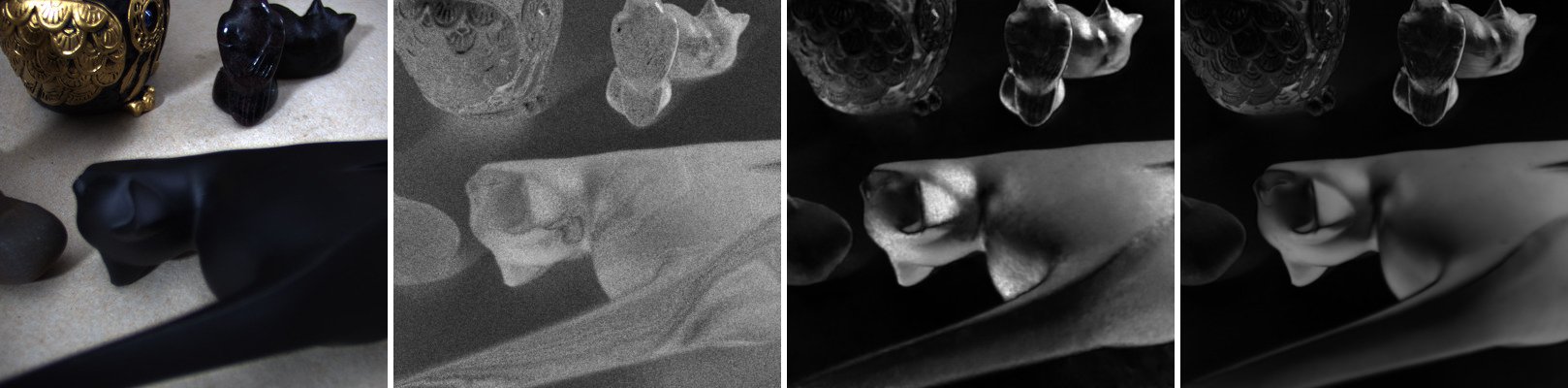
Rotating-analyzer polarization sensors keep full image resolution but normally need a wide angular sweep before they produce a reliable estimate, which makes them too slow for dynamic scenes. PRoPE turns the lab’s sweep instrument into a rolling polarization sensor: it updates the polarization state every frame from the three most recent frames spanning 30°, a 60-fold shorter acquisition window.
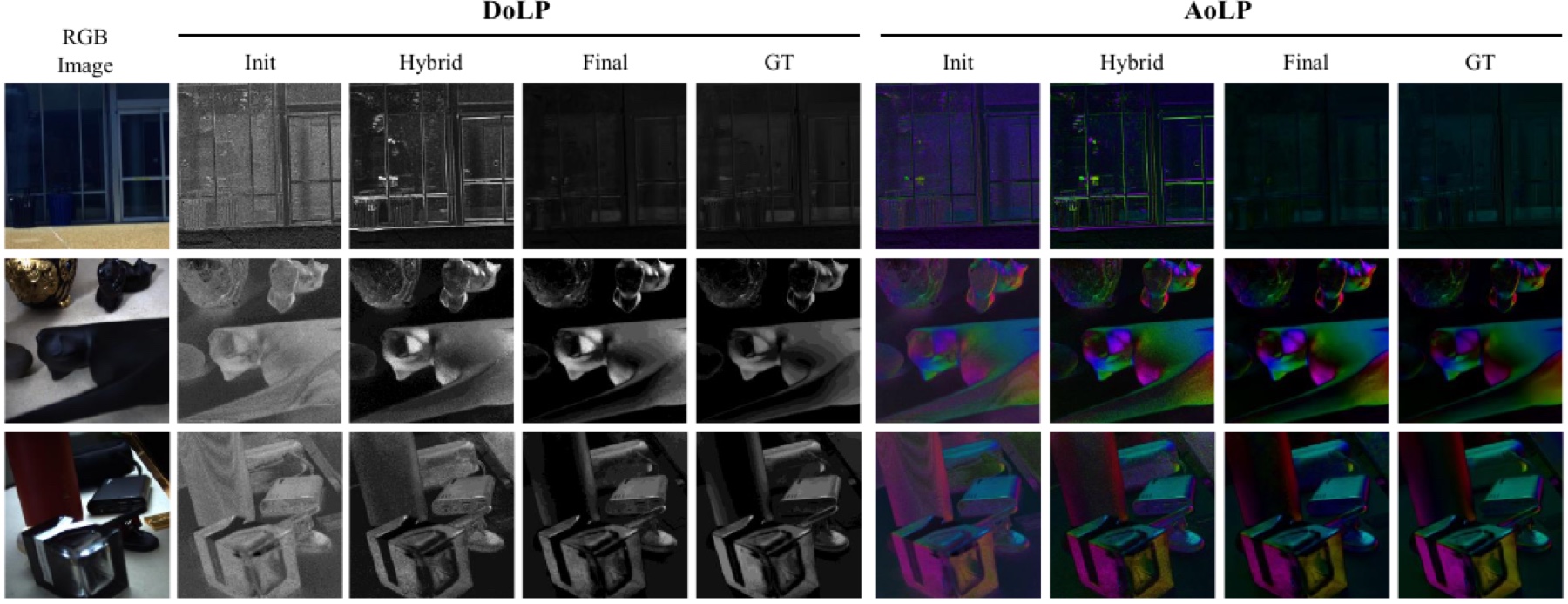
Closely spaced analyzer angles make the standard inversion badly ill-conditioned, so PRoPE is a physics-grounded network rather than a black box. It learns to refine the angle-independent intensity, recovers the remaining polarization components in closed form from the image-formation model, and applies a compact learned refinement. On 529 indoor and outdoor scenes it outperforms four standard image-restoration networks at 12.5 full-resolution frames per second, and its lightweight first stage runs at 128 frames per second.
Image: RGB input, initial closed-form degree-of-polarization estimate, PRoPE result, and dense-sweep ground truth.
Publication
A. Moori, P. Sangani, G. Seetharaman, E. Blasch, and H. Ali Akbarpour. Physics-guided Rolling Polarization Estimation (PRoPE). PhysWorldAI Workshop, NeurIPS, 2026 (accepted).